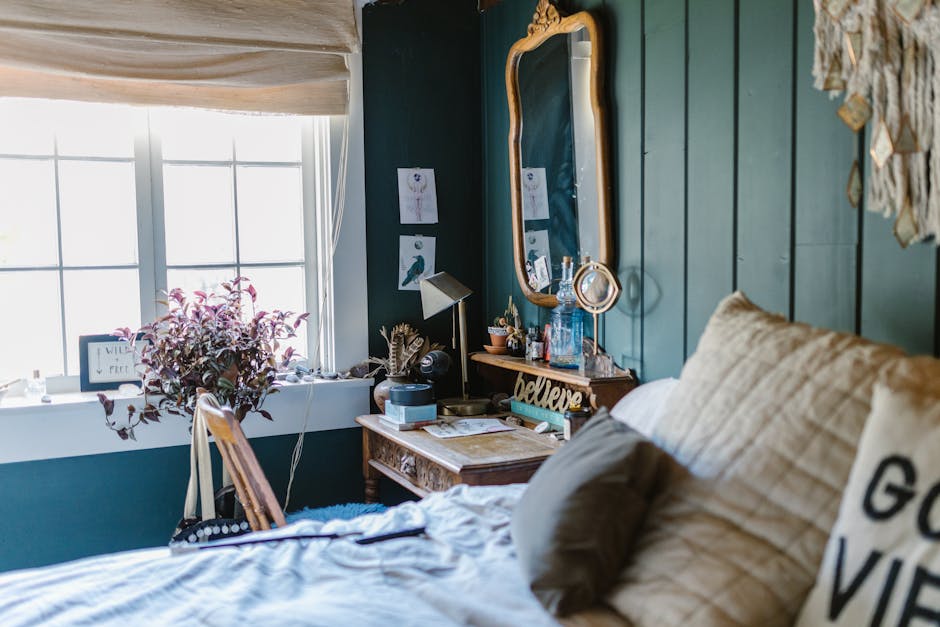
You’ve saved hundreds of bedroom photos. Warm amber light, layered rugs, trailing plants, that particular softness where nothing looks purchased but everything looks right. Then you walk back into your own room — overhead lighting, a bare mattress frame, walls that haven’t changed since you moved in — and the gap feels impossible to close without spending thousands.
Here’s the honest assessment: $800, spent in the right order on the right things, is enough to close that gap. Not every gap. Not a 400-square-foot room starting from scratch. But a standard master bedroom with basic furniture already in place? Absolutely.
The issue is almost never budget. It’s sequencing and product selection.
What “Bohemian” Actually Means in Design Terms
Before spending a dollar, it helps to understand what creates the aesthetic at a structural level — not what it looks like, but why certain rooms feel bohemian and others feel chaotic despite having all the same elements.
The bohemian aesthetic draws from Moroccan, Indian, and 1960s-70s American folk traditions. What unifies them isn’t any single object — it’s the principle of layered imperfection. A convincing boho room feels assembled over years by someone who traveled, inherited pieces, and actually lives in their space. The moment it looks like a single shopping trip, something is lost.
The Three-Layer Framework
Every successful bohemian bedroom operates on three distinct layers:
- Base layer: A warm, neutral foundation — cream walls, warm wood tones, natural fiber rugs that ground the room
- Mid layer: Dominant textiles — duvet, curtains, upholstered headboard if applicable — carrying most of the color or pattern weight
- Surface layer: Accent objects, plants, wall art, throw pillows, baskets — these create the visual interest but only work if the first two layers are solid
When all three align using the same color temperature, the room reads as intentionally designed. When they fight each other — cool gray walls with warm amber textiles, or a modern platform bed surrounded by macramé — it reads as confused rather than eclectic.
The Color Temperature Rule
Rooms that fail the boho test almost always have mixed color temperatures. Warm and cool tones competing with each other is the single most common reason a room looks off even when every individual piece is attractive.
Stick to: terracotta, ochre, rust, sage green, dusty rose, cream, warm white, sand, and tobacco brown. Avoid: cool grays, stark white, anything described as “greige” that leans blue or purple. This isn’t rigid — but deviating from it successfully typically requires more design experience than most people have when starting out.
Why the “Bought Everything at Once” Problem Exists
When every object in a room comes from the same shopping session — same store, same collection, same aesthetic moment — it tends to look sterile regardless of what those objects are. Bohemian rooms that read as genuine mix eras, materials, and price points. A vintage rug bought on eBay alongside an IKEA basket and a thrifted ceramic lamp creates depth. A full curated set from Anthropologie, despite being beautiful, often feels too coordinated to read as bohemian.
The practical implication: plan deliberately to mix your sources. Roughly 40% new, 40% secondhand, 20% DIY or repurposed is a ratio that tends to produce good results.
The $800 Breakdown: Where Every Dollar Goes
Here’s how a realistic $800 budget distributes across a standard bohemian master bedroom, based on what’s currently available at IKEA, Target, World Market, H&M Home, and secondhand platforms.
| Category | Budget Range | Best Sources | Priority Level |
|---|---|---|---|
| Bedding (duvet, shams, 1-2 throws) | $80–$120 | H&M Home, Target Threshold, World Market | High |
| Area rug (8×10 or two layered smaller rugs) | $100–$150 | IKEA, Ruggable, eBay vintage | High |
| Lighting (pendant swap + string lights) | $60–$90 | World Market, Target, Home Depot | High |
| Bed frame or headboard update | $0–$250 | IKEA, Facebook Marketplace | Medium |
| Wall art + macramé | $45–$80 | Target Threshold, Etsy, thrift stores | Medium |
| Plants, baskets, ceramic accents | $60–$100 | IKEA, HomeGoods, local nursery | Low |
| Curtains (2 panels) | $20–$60 | IKEA HANNALILL, Target | Medium |
| Total | $365–$850 |
The wide range on bed frame reflects the biggest variable: buying secondhand versus new. If you already have a usable frame, that $250 ceiling drops to $0, and your whole budget compresses significantly.
Where to Flex vs. Where to Save
Flex on the rug — it anchors the entire room and cheap rugs look exactly that. Save on throw pillows and ceramic accents — thrift stores stock these in volume at $2-$8 each. The IKEA SINNERLIG bamboo basket ($15 new) looks as good in practice as versions selling for $60 at specialty home stores.
Building the Bohemian Bed: Products That Work at This Budget
The bed is the room. Get it right and the rest of the space has room to breathe around it.
The Bed Frame Decision
Natural wood or rattan frames are ideal. The IKEA BRIMNES bed frame (queen, around $230) provides a clean, solid wood-toned base that doesn’t compete with the textiles. For rattan specifically, World Market’s Alondra Rattan Bed Frame runs approximately $400 for a queen — at the upper limit of this budget’s capacity, but a genuine statement piece. Facebook Marketplace consistently surfaces similar rattan or solid wood frames in the $80-$150 range.
If your current frame is metal or aggressively modern, IKEA LILL sheer curtains ($9 per pair) hung from a ceiling-mounted rod can create a fabric canopy that softens or obscures the frame for under $25. It’s a workaround, but it works.
Bedding That Reads Boho Without Announcing It
The H&M Home Washed Linen Duvet Cover Set (queen, approximately $80) comes in terracotta, sage, and warm cream — all three sit cleanly within the bohemian palette. Texture matters as much as color: washed linen and cotton gauze read as bohemian; crisp percale reads as hotel. For a more pattern-forward approach, the World Market Marta Medallion Duvet (~$90) uses a traditional geometric print that signals the aesthetic without being heavy-handed. Layer either with a Target Threshold Studio Waffle Knit throw (~$30) draped across the foot of the bed.
The Pillow Layering Formula
Standard arrangement for a queen: two euro shams (26 inches) against the headboard, two standard sleeping pillows in solid or linen cases in front, then two to three decorative throws stacked at an angle in front of those. Use at most two patterns — one geometric or printed, one solid or textured. The Urban Outfitters Yaro Woven Throw Pillow ($28 each) has a convincingly hand-woven texture that reads well against linen bedding.
Lighting Changes a Room More Than Any Other Single Element
Fix the lighting before anything else. Overhead LED ceiling lights — the flat disk, the builder-grade globe, any fixture installed as a default — will actively undermine every other decision you make. Warm textiles, plants, and macramé cannot coexist convincingly with cool overhead fluorescent light. The physics of it don’t cooperate.
The minimum intervention: stop using the overhead light entirely. Use lamps, pendants, and string lights instead.
The Pendant Swap
World Market’s Rattan Woven Pendant Light runs $60-$70 and installs like any standard pendant fixture. For renters, IKEA’s HEMMA cord set ($8) paired with a rattan or paper globe shade works mounted to a floor lamp base or hooked from the ceiling with an adhesive hook. Pair either with a vintage-style Edison bulb — the Feit Electric Vintage ST19 ($8 for a 2-pack at Home Depot) emits warm amber light in the 2200-2700K range, which is the correct temperature for this aesthetic.
String Light Placement That Doesn’t Read as a College Dorm
The mistake everyone makes: draping string lights around a mirror or above a headboard in a straight horizontal line. This reads as 2012 Pinterest, not intentional design. Instead, use them to define a corner — loose draping down a curtain panel, or across the ceiling above the bed using small adhesive hooks at irregular intervals. The Brightown 33-foot globe string lights (~$18 on Amazon) have warmer, more diffused bulbs than a standard thin fairy light strand, which matters at close range.
Rugs, Macramé, and the Mistakes That Unravel the Look
A rug that’s too small is the most frequent single failure in bohemian bedroom attempts. In a room with a queen bed, an 8×10 or 9×12 is typically correct. A 5×8 rug pushed only under the lower portion of the bed reads as accidental, not designed. Size up before you compromise on pattern.
Which Rugs Work at This Price Point
The IKEA HAMPEN rug (5’3″x7’7″, approximately $80) has a flat-woven texture that works well as a layering piece under a smaller vintage kilim or as a bedroom entry rug. For a single statement rug, Ruggable’s Jaipur Collection starts around $150 for a 5×7 — washable and patterned with designs that sit authentically within the bohemian range. For the best possible result at this budget, eBay and Facebook Marketplace regularly surface genuine vintage Turkish or Persian flat-weave rugs in the $60-$120 range that no mass-market product can replicate for character and depth.
Hard avoid: shag rugs in synthetic fibers (they mat and pill within months), anything in the gray or cool-tone palette, and the ubiquitous black-and-white “Moroccan trellis” diamond pattern — it’s been overused to the point where it reads as trend rather than design.
Macramé Without the Craft Fair Problem
One large macramé wall hanging is a legitimate design element. Three medium ones arranged as a gallery tips the room from bohemian into craft supply store. The Target Threshold Large Macramé Wall Hanging (~$45) is well-proportioned for most walls. For something with more handmade irregularity, Etsy sellers in the $50-$90 range offer hand-knotted pieces with texture variation that mass-produced versions don’t achieve.
Curtains: The Detail That Changes Room Height
IKEA HANNALILL sheer panels ($20 per pair) in off-white or ecru create the diffused natural light that makes a bohemian room feel warm during daylight hours. The installation detail matters more than the curtain itself: mount the rod at ceiling height — not at window frame height — and let the panels touch or slightly pool on the floor. This single adjustment adds perceived height and softness that has a disproportionate effect on how the room feels.
What to Thrift and What to Buy New
Not every category benefits from thrifting equally, and buying everything secondhand introduces hygiene and quality risks worth understanding before you commit.
- Always thrift: Ceramic vases, wooden trays, wicker baskets, rattan side tables, vintage mirrors, decorative books, candle holders, throw blankets in natural fibers
- Buy new: Duvet covers and pillow cases (hygiene), curtain panels (consistent sizing and cleanliness), pendant light fixtures (inspect wiring carefully if secondhand), area rugs larger than 5×8 (odor and staining are hard to assess in photos)
- Either works well: Throw pillows (buy new inserts, thrift covers), bed frames (Facebook Marketplace is reliable if you inspect in person), framed art prints
HomeGoods and TJ Maxx deserve a specific mention here. They consistently stock ceramics, woven baskets, and textural accents at 40-60% below specialty home retailers. A single HomeGoods run before buying anything from a dedicated boho brand typically surfaces 5-8 usable pieces at $8-$25 each that would cost $40-$80 at West Elm or Anthropologie.
For plants: a monstera deliciosa or fiddle-leaf fig from a local nursery runs $20-$35 for a medium specimen. A snake plant (Dracaena trifasciata) costs $12-$18 and survives near-total neglect — the honest pick for anyone who wants the aesthetic without committing to plant care. Two or three plants in the room is enough. More than four and the room starts to feel like the plants are the point rather than the backdrop.
When $800 Won’t Be Enough
If your bedroom is larger than roughly 200 square feet, or you’re starting with no furniture at all — no frame, no dresser, nothing — then $800 will produce a room with the right elements that still feels sparse. Phase it: spend the first $500 on bedding, lighting, and one statement rug, then add layers over the following months as secondhand finds surface. Incremental assembly, as it turns out, produces more convincing bohemian results than buying everything at once anyway — which is the whole point of the aesthetic to begin with.