The number-one reason people buy outdoor speakers twice is simple: the first one died before the warranty expired. Not because of a bad battery. Because moisture crept into the charging port, UV rays hardened and cracked the rubber seal around the driver, or one drop onto a concrete deck finished what weather had started. I’ve been through four speakers on my back patio over six years. I’ve learned things the hard way that nobody in a product listing will tell you.
The real problem is that most people shop for outdoor speakers using indoor criteria — sound quality scores, volume ratings, price. Every single one of those metrics is tested indoors. A speaker that sounds warm and full on a reviewer’s desk will sound thin and directionless on your patio table at 12 feet. What determines outdoor performance is almost entirely different from what determines indoor performance.
Why Outdoor Audio Is a Completely Different Engineering Problem
A living room is an acoustic box. Sound bounces off walls, floors, ceilings, and furniture — which means even a $30 speaker sounds reasonably full indoors because the room does most of the acoustic work. Walk outside and none of that help exists. Open air swallows bass frequencies fast. Every additional foot of distance from the speaker costs you volume. Wind direction determines whether someone sitting three feet away can hear the music clearly or not.
This is why a speaker with stellar reviews used inside a home can feel weak and hollow when you move it to the deck. The solution isn’t always a louder speaker — it’s understanding which specs translate to outdoor performance and which ones don’t.
What IPX Ratings Actually Mean in Practice
The IPX scale runs from 0 to 8. Most buyers see the word “waterproof” on a box and assume protection is either present or not — binary. It isn’t.
IPX4 means the speaker handles splashes from any direction. Fine for light drizzle, not fine if you’re near a pool or hose. IPX6 means it survives powerful direct water jets from any angle — this is the practical outdoor minimum for uncovered decks or poolside use. IPX7 adds full submersion up to 1 meter for 30 minutes. For a covered patio, IPX4 is sufficient. For open decks and anywhere rain hits directly, IPX6 is the floor.
The Pro Portable Magnetic Bluetooth Speaker (3rd Gen) at $59.99 carries an IPX6 rating plus shockproof construction — meaning it survives the drop onto deck tiles that’s basically inevitable. With 1,679 reviews averaging 4.6 out of 5 stars, it’s the most extensively tested option in its price range, and the rating has held up across a large enough sample to trust. JBL rates their Charge 5 at IP67 — both dust and water sealed, plus 1-meter submersion capability — at $179.95. That’s the benchmark if budget isn’t the constraint.
Why Bass Sounds Weaker Outdoors and What Hardware Actually Fixes It
Low frequencies lose energy faster in open air than high frequencies. The physics isn’t subtle. A speaker that punches hard in a kitchen sounds thin at 10 feet on an open deck. You cannot EQ your way out of this problem permanently — boosting low EQ on a small driver just compresses and distorts at volume. The only real solutions are hardware: larger drivers, passive radiators, or increased wattage output.
The JBL Charge 5 uses dual passive radiators. The Sony SRS-XB43 ($148) adds a dedicated extra bass driver alongside the main woofer. The UE Hyperboom ($449) runs four drivers aimed at 360-degree coverage to compensate for outdoor dissipation. Budget speakers typically just boost the low EQ and call it “deep bass” in the marketing copy. That sounds fine in a quiet room and muddy at 15 feet outdoors. If a listing advertises bass quality without mentioning a passive radiator, a second driver, or specific wattage output, it’s almost certainly just EQ.
Why Magnetic Mounting Changes Your Entire Patio Setup
I dismissed magnetic mounting as a gimmick aimed at golfers when I first saw it. That was a mistake. A strong magnet base means you can fix the speaker directly to a metal grill body, a steel-framed umbrella stand, a pergola crossbeam with a metal bracket, or the side of an outdoor cart rail — and it stays there. Wind doesn’t knock it. Vibration from music doesn’t slide it off. Nobody brushing past the table sends it tumbling.
The Dprofy New Play 2 Rounds at $79.96 pairs magnetic mounting with an ambient LED light ring, which I initially assumed was decorative filler. Used at dusk on a patio, the ring puts out enough soft light to feel atmospheric without being distracting. Its 4.5/5 rating across 279 reviews is a smaller sample than the Pro 3rd Gen’s pool, but it’s held consistently. Both models support TWS stereo pairing, which turns out to be more important than almost any other spec on this list.
How the Main Portable Outdoor Speakers Compare Side by Side
Prices reflect 2026 retail. Battery life ratings are manufacturer-stated at moderate volume:
| Speaker | Price | Water Rating | Battery Life | Magnetic Mount | TWS Support | Best Use Case |
|---|---|---|---|---|---|---|
| Dprofy New Play 2 Rounds | $79.96 | Waterproof | ~12 hr | Yes | Yes | Evening patio, ambient lighting |
| Pro Portable Magnetic 3rd Gen | $59.99 | IPX6 + Shockproof | 24 hr | Yes | Yes (+ SD Card) | All-day outdoor, best budget pick |
| JBL Charge 5 | $179.95 | IP67 | 20 hr | No | PartyBoost only | Premium, poolside, audio quality |
| Bose SoundLink Flex | $149 | IP67 | 12 hr | No | Limited | Close-range audio quality |
| Sony SRS-XB43 | $148 | IP67 | 24 hr | No | Yes | High-volume outdoor gatherings |
| UE Hyperboom | $449 | IPX4 | 24 hr | No | Yes (PartyUp) | Large outdoor spaces, 360° fill |
Two things stand out from this comparison. The Bose SoundLink Flex at $149 only delivers 12 hours of battery life — the same as the $79.96 Dprofy. At that price point, 12 hours is a real limitation for all-day outdoor use. The Flex sounds genuinely excellent for close-range listening, but if you’re running music through a dinner party and into the evening, plan on a mid-session charge. The Sony SRS-XB43 hits both the 24-hour battery and IP67 durability marks at $148, which is why it keeps showing up as the practical recommendation in the $130-$160 range for people who don’t need magnetic mounting.
The Battery Minimum for Patio Use Is 20 Hours
Anything rated below 20 hours means you’re charging between morning use and evening use — or cutting a party short. The Pro Portable Magnetic 3rd Gen’s 24-hour battery is the standard worth matching. If the two speakers you’re comparing are otherwise similar, always take the one with more battery. That spec will frustrate you more consistently than any other once you’re actually using it outdoors.
Six Placement Mistakes That Ruin Outdoor Sound Quality
Setup matters as much as the speaker itself. Most patio audio disappointment comes from placement decisions, not hardware limitations.
- Placing it on the ground. Sound projects forward and upward from the driver. At ground level, you lose a significant portion of effective coverage before the audio reaches seated listeners. Position the speaker at waist height minimum — on a side table, a cooler lid, or mounted to a structure at 3 to 4 feet off the deck surface.
- Pointing it toward a wall instead of the seating area. Most portables have a clear front-facing output with noticeably less projection from the rear and sides. Seat-facing orientation matters. Omnidirectional designs are more forgiving, but they’re the exception, not the rule.
- Staying connected from too far away. Bluetooth 5.0 has a theoretical 300-foot open-air range. Practical outdoor range with one or two obstructions drops to 30 to 50 feet. For reliable, dropout-free connection, keep your phone within 25 feet of the speaker.
- Using one speaker when two in stereo would cost the same. Two matched units in True Wireless Stereo mode cover more area with cleaner separation than one speaker at maximum mono volume. This is almost always the better configuration for a patio with seating spread across 15 or more feet.
- Ignoring what surface the speaker rests on. Hard surfaces — concrete, wood decking, metal furniture — reflect and reinforce bass. Soft surfaces — outdoor cushions, lawn, fabric chair seats — absorb it. If bass sounds thin, move the speaker to a harder nearby surface before buying a different speaker.
- Leaving it outside overnight. IPX6 and IP67 ratings describe resistance to water impact during use, not indefinite exposure to ambient humidity while powered off. Prolonged moisture exposure in a non-operating state accelerates internal corrosion faster than active rain. Bring it in after use.
TWS Stereo Pairing Is the Most Underused Patio Audio Upgrade
Buy two of the same speaker, pair them in True Wireless Stereo mode. This is the single largest practical audio upgrade most patios aren’t using — and it almost always costs less than buying one premium single unit.
The math is direct: two Pro Portable Magnetic 3rd Gen units in TWS mode total $119.98 and give you full left-right channel separation across your deck. One JBL Charge 5 at $179.95 gives you better audio fidelity from a single point. For a patio with guests spread across 20 feet of space, the TWS pair covers the room better. For one or two people sitting close, the JBL sounds more refined. Pick based on your actual use pattern, not marketing descriptions of “powerful output.”
How the TWS Signal Chain Actually Works
In TWS mode, one unit acts as the master — it receives the Bluetooth signal from your phone and relays it wirelessly to the second, slave speaker. The two speakers connect to each other, not independently to your phone. The relay latency between units is typically 1 to 5 milliseconds, which is below the threshold of human auditory perception. You won’t hear the gap.
The practical implication: you only need your phone within range of one speaker. The second speaker can be placed up to 30 to 50 feet away (the speaker-to-speaker Bluetooth range) without any phone proximity concern. You can run one unit at the grill end of the patio and another at the seating end — phone stays near you, both speakers stay connected.
What to Verify Before Buying Two Units for Pairing
Not all TWS systems are cross-compatible. JBL’s PartyBoost protocol only pairs between PartyBoost-supported JBL models — you cannot pair a JBL Charge 5 with a JBL Flip 6 even though both carry the JBL name. UE’s PartyUp has the same constraint. Generic Bluetooth TWS works between two identical units of the same model from any brand that supports it.
Check the product listing specifically for “TWS pairing” or “stereo pairing” language before assuming support exists. The Dprofy New Play 2 Rounds lists TWS pairing as a core feature — mount two units magnetically on opposite anchor points of your patio structure, engage TWS mode, and you have stereo spread at under $160 combined. That is the configuration I run now, and it outperformed every single speaker I bought individually in the six years before it.
When a Portable Speaker Is the Wrong Choice Entirely
Portables are correct for most patio setups. But two specific situations make permanent outdoor speaker installation the smarter investment — and continuing to buy portables just delays an inevitable upgrade.
Large Outdoor Spaces Break the Portable Speaker Math
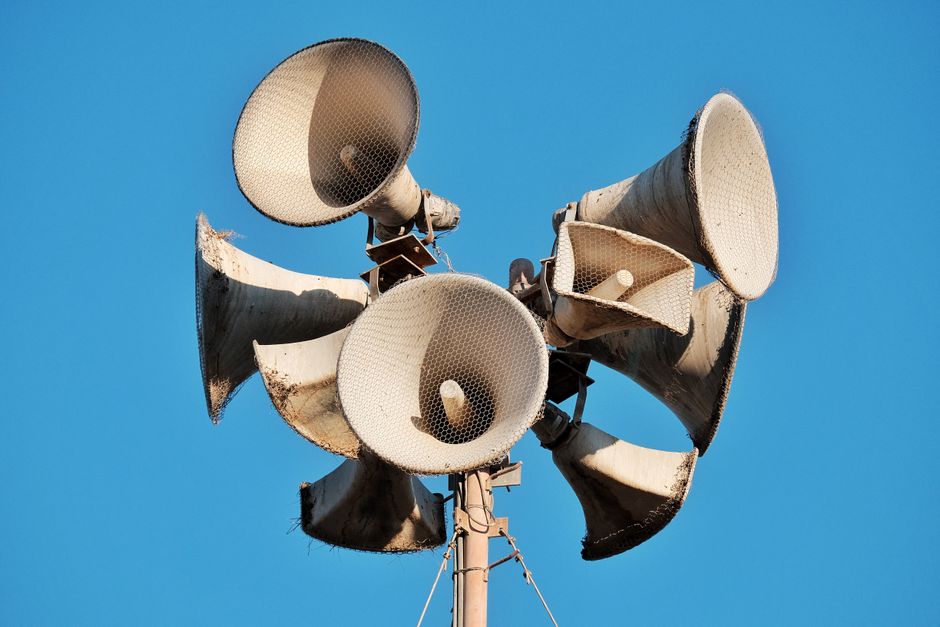
Most portable speakers deliver 85 to 90dB at one meter. Volume decreases by 6dB every time you double the listening distance. At 4 meters (about 13 feet), you’re down to roughly 72 to 78dB. Ambient outdoor noise — wind, neighbors, traffic — runs 55 to 65dB in most residential settings. For a 400-square-foot open deck with guests spread out, one portable placed at one end simply won’t fill the space at a comfortable listening level without maxing out the volume and distorting.
Permanent outdoor speakers mounted at height and angled toward the seating area solve this problem in a way portables can’t replicate. The Polk Audio Atrium 4 ($99 per pair, 89dB sensitivity, 40Hz to 20kHz frequency range) is the standard recommendation for covered patios and smaller open decks. The Klipsch AW-650 ($299 per pair, 94dB sensitivity) handles larger open spaces and louder environments. Either option, mounted 8 to 10 feet high and powered by a basic outdoor-rated receiver, will outperform any portable for large-area coverage — and both are engineered to survive outdoor temperature cycling, UV exposure, and moisture for a decade or more with minimal maintenance.
The Six-Year Cost Comparison Favors Permanent for Regular Use
A mid-range portable speaker lasting two years — which is optimistic for outdoor use — costs $60 to $150 and needs replacement. Over six years: $180 to $450 in portable speakers alone, plus the time spent setting up and breaking down before and after each use. A permanent Polk Atrium 4 system runs approximately $99 for speakers, $150 for a basic outdoor-rated receiver, and $40 in wire and mounting hardware — around $290 total, installed once, running for 10-plus years without replacement.
The decision splits cleanly. Renting? Portables. Want something that travels with you to the beach or a friend’s place? Portables. Own your home, use a large patio regularly, and plan to stay? Run the numbers on permanent installation. The break-even against replacing portables happens faster than most people expect.
Six years of failed speakers, water-damaged ports, and degraded rubber seals later, that’s where I landed — two magnetic portables in TWS stereo mode for a medium-sized covered deck, with permanent Polk Atrium 4s on a second, larger open patio where coverage range made portables impractical. The first speaker I replaced after my very first patio season had cost $89 and promised to be waterproof. The label on the charging port said IP44. I didn’t know what that meant at the time. Now I do — and so do you.