You rearranged the furniture twice. Bought the right rug. Found a decent sofa. And the living room still feels like a room that’s waiting to become something. No focal point. No warmth. Nothing to actually look at when you sit down .
This is the exact problem an electric fireplace solves — not just heat, but a reason to look at a wall. The installation decisions, though, determine whether the result looks like a design choice or an afterthought. A fireplace mounted on bare drywall with nothing around it is worse than no fireplace at all. It draws attention to how unfinished everything is.
What follows are six specific approaches that work — with real measurements, real product names, and real costs. This is not professional design advice — always consult a licensed contractor before making structural changes to walls or electrical systems.
The Recessed Wall Niche: Highest-Impact Install, Most Difficult Execution
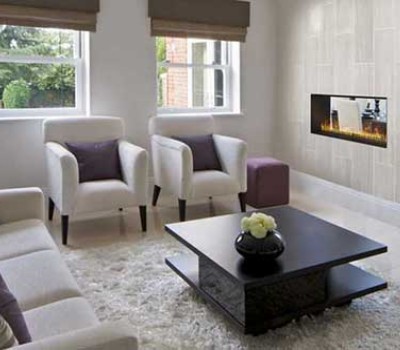
The flush-mount niche is what most people see in design magazines and immediately want. The fireplace sits inside the wall rather than hanging on it. No visible gaps around the frame. No depth sticking out. It looks like the house was built with it there.
Getting there requires cutting into the wall, framing the opening, finishing the drywall interior, running an electrical outlet into the cavity, and sliding the unit flush. None of those steps are complicated in isolation. The problem is executing all of them to a standard that makes the final result look clean rather than visibly DIY.
How deep does the niche need to be?
This depends entirely on which unit you buy, and it’s the first spec to verify. Standard residential interior walls are 4.5 inches deep (3.5-inch stud plus 0.5-inch drywall on each face). Most electric fireplaces designed for recessed installation need 4–6 inches — meaning you’re cutting into the stud cavity but not through it.
The Touchstone Sideline 50″ ($549) needs only 2.5 inches and is specifically engineered for tight wall installations. It’s the most forgiving option for retrofit projects. The Napoleon Allure Phantom 50″ ($899) goes further — built for zero-clearance installation, meaning combustible materials can go directly against it. These two are the practical reference points for recessed niche builds.
If you’re running tile or stone flush with the fireplace frame, the Phantom’s zero-clearance spec is what makes this possible without an air gap that catches dust and looks perpetually unfinished.
The electrical detail that trips up first-time installers
The outlet must be inside the niche, positioned at the top or bottom of the cavity interior — not behind the back of the unit. Running the outlet to the rear wall and plugging in from there creates a cord management problem with no clean solution. Budget $100–150 for an electrician to add a dedicated 15-amp circuit to the niche interior if one doesn’t exist nearby.
Total project cost runs $700–1,500 depending on whether you finish the drywall yourself or pay a contractor. Rough drywall edges around a fireplace look worse than no niche at all — if you’re not confident in the finishing, pay someone to do it right the first time.
Bottom Line: The recessed niche is the only installation approach that makes an electric fireplace look genuinely architectural. The $300–500 premium over a surface mount is justified if this room is a priority.
Why Most Electric Fireplace Setups Look Wrong
A short, honest list of where these installs consistently fail — not because of the product, but because of the decisions made around it:
- Wrong size for the wall. Fireplace width should be roughly two-thirds the width of your primary sofa. For an 84-inch sofa, that’s a 56-inch minimum. Most people default to a 36″ or 40″ unit because the price is lower. A correctly proportioned room looks intentional. An undersized fireplace looks like a mistake that’s too expensive to undo.
- No surround whatsoever. A metal box surface-mounted directly on painted drywall looks like equipment, not a design feature. The fireplace needs something around it — tile, trim boards, shiplap, a built-in cabinet — to read as part of the room’s architecture. The surround doesn’t have to be expensive. It has to exist.
- Cheap flame technology in a visible room. The lowest-tier units project a looped image of fire onto a flat LED panel. The tell is that the flames don’t interact with the surrounding logs and look pixelated from across the room. These units have their place. The living room focal point is not it.
- Style mismatch with existing furniture. A sleek black linear fireplace with brushed steel trim looks wrong in a room furnished with traditional upholstery and carved wood pieces — and vice versa. The fireplace should share the room’s visual vocabulary, not contrast with it for an effect that rarely reads as intentional.
- Visible power cord. A single cord snaking down the wall undermines any installation, regardless of how good the rest of the work is. In-wall cord concealment kits cost $25–40 and take 30 minutes. There is no reason to skip this step.
The pattern is consistent: the fireplace itself is rarely the problem. The problem is everything decided — or left undecided — around it.
TV and Fireplace Media Walls: What Each Setup Actually Costs
The media wall concept — fireplace and TV combined as a single architectural unit — is the most searched electric fireplace idea on every design platform. It works because it gives one wall a clear purpose. One focal point. Nothing competing with it.
| Setup Type | Fireplace Cost | Build Cost | Total Range | Best For |
|---|---|---|---|---|
| DIY shiplap + surface mount | $350–600 | $100–300 | $450–900 | Renters, short-term spaces |
| Professional drywall niche | $500–1,200 | $400–800 | $900–2,000 | Homeowners, permanent install |
| Custom millwork cabinet | $800–2,000 | $1,500–4,000 | $2,300–6,000 | High-end permanent builds |
| Tile or stone veneer accent wall | $600–1,500 | $800–2,500 | $1,400–4,000 | Traditional or transitional rooms |
The TV height problem nobody plans for until it’s too late
Seated eye level is typically 42–48 inches from the floor. The center of your TV should land in that range. A fireplace center sits at 18–24 inches. Bridging that gap requires a deep media console, a stepped millwork build, or deliberate proportioning in the design phase — otherwise the TV ends up too high and you spend months watching with your neck tilted before admitting it’s uncomfortable.
The Amantii Panorama Deep series is the most commonly specified fireplace for media wall builds because it comes in six widths: 40″, 50″, 60″, 72″, 74″, and 88″. That range means it can match almost any TV width precisely. Visual alignment between the fireplace width and the TV above it is what makes these builds look designed rather than assembled from whatever was available.
Heat and electronics: the concern is mostly overstated
Most electric fireplaces push heat forward through the base of the unit, not upward. Modern flat panels tolerate ambient temperatures up to roughly 100°F before performance degrades. In a ventilated room at normal thermostat settings, 1,500W below a TV doesn’t approach that threshold. The risk appears with poorly ventilated enclosures or units with upward-directed heat vents. Look for “cool-touch glass” in the product specs — the Dimplex Revillusion series ($699–899) specifically engineers against heat buildup at the glass face and is the standard recommendation for enclosed media wall builds.
Bottom Line: A media wall build is the highest-return living room upgrade under $2,000 — it solves the focal point problem and the TV mounting problem in one project.
Corner Placements Are the Right Answer for Certain Rooms
If the room is under 200 square feet, a corner fireplace is often the correct choice — not a compromise. Corner units are visible from multiple seating positions simultaneously, which a flat-wall fireplace cannot replicate, and they fill space that would otherwise be dead. The ClassicFlame 26II100GRG 26″ Curved Corner Electric Fireplace ($280–350) fits spaces where forcing a linear wall-mount would either overpower the room or leave it looking wrong from half the seating positions.
Corner units are not a consolation prize. They are the right answer for specific room configurations, and dismissing them in favor of the more photographable linear format is one of the more common small-room mistakes.
Bedroom Fireplaces: Three Questions That Determine Whether This Works
Does a bedroom fireplace add atmosphere or just unwanted heat?
Both — and which one dominates depends on how you use the controls. The flame effect at zero heat output is a genuinely useful ambient light source: slower and warmer than a TV, easier to sleep adjacent to than a reading lamp left on. On the heat side, a 750W/1,500W switchable unit lets one occupant add warmth without running the whole HVAC zone. At 750W, you’re spending roughly $0.09 per hour. Running it for two hours each evening costs around $5.40 per month — it won’t register on your electricity bill.
Where exactly should the fireplace go in a bedroom?
Opposite the bed or on the wall to the left or right of the headboard — never at the foot of the bed, where it becomes an active visual distraction rather than background atmosphere. For renters, the Dimplex Mini Cube (~$200) sits on a dresser or media console and requires zero installation. For a permanent master bedroom feature, the MagikFlame 3D ($1,095) uses water vapor to produce a realistic flame with actual rising mist — the most convincing flame effect available at this price point. It’s worth considering when the fireplace is the room’s primary design element, not a secondary accent.
What wattage is appropriate for a bedroom?
750W is almost always enough. A standard bedroom (100–180 sq ft) reaches a 4–6°F increase within 45–60 minutes at 750W. Running 1,500W in a small enclosed space isn’t dangerous — it just overshoots any reasonable temperature target within 20 minutes, at which point you either open a window or turn the whole thing off. Nearly every modern unit offers dual heat settings. Use the low setting in bedrooms.
The Floating Mantel Shelf: Most Visual Return Per Dollar
Surface-mounting an electric fireplace on a blank wall makes it look like a piece of equipment someone plugged in and left there. Add a floating mantel shelf above it and a simple tile or shiplap surround around the unit and it reads as an architectural feature. The cost difference is $150–400 in materials.
No other upgrade changes the perceived quality of an electric fireplace installation so completely for so little money. This is the move most people skip because it feels like extra effort after the fireplace is already up — and it’s the reason their room looks incomplete for years afterward.
Specific materials that work
- Floating wood mantel shelf: $80–180. Solid oak custom mantels from Etsy makers run $150–250 and look substantially better than thin retail shelf options. Shelf depth should be 6–8 inches — deep enough to display objects, shallow enough not to project awkwardly into the room.
- Peel-and-stick subway tile for the surround: $2–4 per square foot. A 3′ x 4′ surround area needs roughly 12 square feet — total material cost $25–50.
- Primed MDF trim boards to frame the fireplace edges: $30–60 from any hardware store. These create the defined boundary between fireplace and wall that makes the installation look intentional rather than floating in empty space.
The frame matters more than the flame
Budget electric fireplaces have thick plastic bezels — typically 2–3 inches of glossy black plastic around the glass face. That bezel is the immediate visual signal that the unit is consumer-grade, regardless of how elaborate the surrounding build is. The Napoleon Alluravision 42″ Deep ($1,199) has a 2.5-inch slim frame that reads as genuinely architectural when surrounded by tile and a mantel shelf. For tighter budgets, the Touchstone Sideline Elite 50″ ($599) has a brushed aluminum frame thin enough to pass as a high-end insert when properly framed.
The surround budget should be at least 25% of the fireplace cost itself. A $500 fireplace with a $150 surround looks like a considered design decision. A $500 fireplace mounted on nothing looks like the project ran out of steam.
Bottom Line: Spend on the surround before spending on a more expensive flame effect — the frame changes the reading of the entire installation more than the technology inside it does.
The difference between an electric fireplace that looks stunning and one that looks like a mistake is almost never the flame effect — it’s whether the unit is correctly sized, properly framed, and installed in a space that was designed around it rather than just cleared for it.